By Chi · 22 April 2026
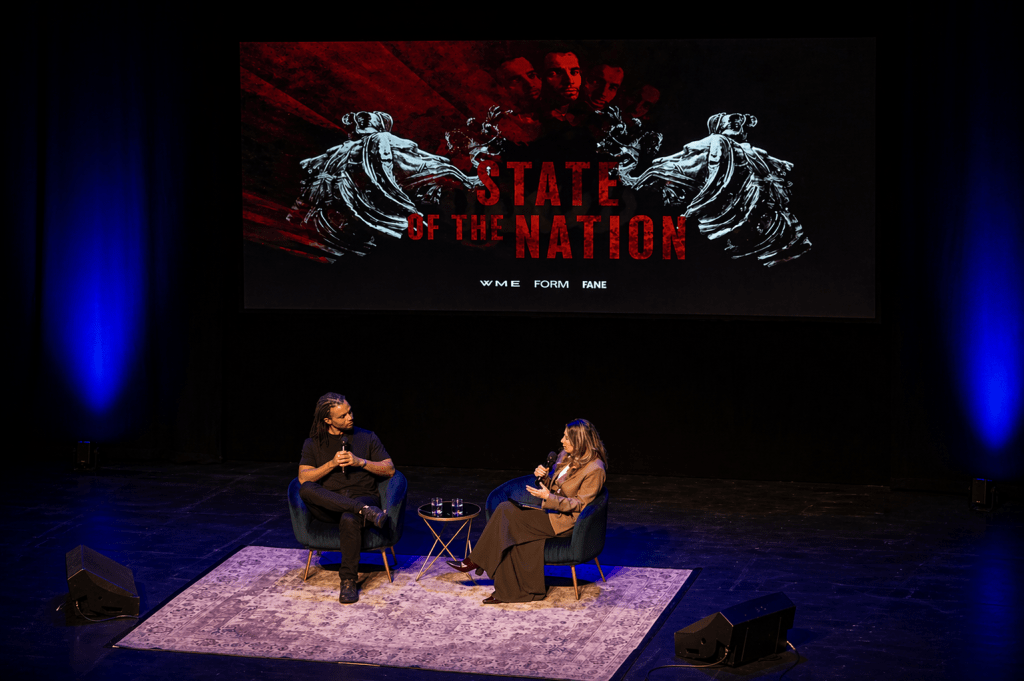
If you have been paying attention to race and identity in British politics over the last decade, you will understand why an evening with Akala felt like a timely thing to attend right now. I have been following his work for a good portion of that time, and having noticed how quiet he had been over the last few years, I was genuinely curious to see where his thinking had landed. So I found myself at The Lowry in Salford on the 20th of April for the final night of his State of the Nation tour. Here is what was covered, why some of it is relevant to this platform, and what I personally took from it.
Who Is Akala and Why Am I Writing About Him Here
Akala is a British rapper, author and social commentator who has spent the best part of a decade making the case that race and class in Britain are more connected than most public conversation allows. He is probably best known for Natives, a book he published in 2018 that sits somewhere between memoir and history. It traces those themes through his own experience of growing up mixed race and working class in London, and it is relevant to what we do at Okwu ID because the question he keeps returning to is one we are also trying to answer: who controls the way a community is understood, and what does it cost when that control sits entirely outside the community itself. Reading it helped me put clearer language to something I had already been thinking about.
He is not the only person making these arguments, and I would not hold everything he says as settled fact. But he makes them plainly and he backs them up, which in this space is worth something.
What the Evening Was Like and What It Covered
The evening was set up as a conversation between Akala and The Scouse Oracle, a Merseyside-based commentator who asked the questions and kept things moving. It was closer to an interview than a lecture, informal enough that it gave him room to move between topics, and over the course of about two hours he covered quite a lot of ground.
Among other things, the evening touched on:
- Class and the education system, and how intellectual curiosity in working class children is often treated as something to be managed rather than developed
- How narratives about communities get constructed, repeated and eventually internalised, including by people within those communities
- The mechanics of scapegoating: how economic frustration gets redirected toward the most visible and least powerful targets
- The rise of the far right in Britain, and what a Reform government in 2029 could mean in practice
- Masculinity and the manosphere, and how real grievances among young men are being captured by well-funded bad-faith actors
- Gaza, media control, and where that control is starting to break down
- Community organising and what people should practically be doing now
A few of these I want to go into more detail on, particularly the ones that connect most directly to identity and to the platform.
Meritocracy, Narratives, and Who Gets Believed
The class system and how it reproduces itself
One of the clearest threads of the evening was about class. Akala has worked across close to a thousand schools, from elite private institutions to underfunded community schools in difficult environments, and his argument is that what actually separates outcomes is not intelligence but access, expectation and resources. He described British society as:
“basically committed to class hierarchy that pretends that it isn’t”
Akala, State of the Nation, The Lowry, 20 April 2026
The illustration he used was quite specific. Children in private schools with learning difficulties still leave with their basic qualifications, because the school throws resources at the problem until it is solved. That does not happen in underfunded schools. So the gap we call ability is often just the gap in support, and we have built an entire ideology of meritocracy on top of it.
Believing things that are not true
One of the more honest moments of the evening was when he talked about narratives people absorb about their own communities. He gave a personal example: he had spent years accepting the absent Black father narrative without questioning it, and only when he actually looked at the data did he find it did not hold up. He said the pattern follows economic instability rather than race, and that countries with similar histories of political and economic disruption show similar family structures regardless of ethnicity. It was only ever framed as a racial failing when it was happening to Black people.
What made the point land was that he included himself in it:
“We can believe narratives even about our own community that often don’t stand up to empirical scrutiny if we’re not careful.”
Akala, State of the Nation, The Lowry, 20 April 2026
I cannot independently verify all of the specific figures he cited, but the broader point, that we absorb narratives about our own communities because they have been repeated long enough to feel like common sense, is worth sitting with regardless.
Identity, Black Britishness, and Why Framing Matters
What we mean when we say Black British
This is where the evening connected most directly to the work of this platform, and I want to be precise about something before going further.
Black British is, at its most basic, a descriptive term for people of sub-Saharan African descent who were born and raised in Britain. That includes British Nigerians, British Jamaicans, British Ghanaians, British Somalis and others, and these are communities with real cultural differences between them. A British Nigerian experience and a British Jamaican experience have things in common, but they are not the same thing. In some ways the shared ground between British Nigerians and British Indians might be just as significant as anything shared between British Nigerians and British Jamaicans. The label groups people together across genuine differences, and that matters when we talk about who controls what gets attached to it.
The control problem
Black diaspora communities in Britain do not own or control the dominant media, and we do not set the agenda for how Black life in this country gets reported. That means the image of Black Britishness that circulates most widely is not one we produced. It is one produced by institutions that have, historically and in the present, associated Blackness with crime, dysfunction and threat. Akala writes about this in Natives:
“As long as whiteness is a metaphor for power, blackness must of course function as a metaphor for powerlessness, and as long as money whitens, poverty must blacken.”
Akala, Natives: Race and Class in the Ruins of Empire, 2018
The negative associations attached to Blackness are not random. They serve a function, and because they are reproduced through institutions with far more reach than anything Black communities in Britain can currently counter, the image sticks.
Why the framing matters: the Epstein example
Akala made a point on the night about media framing that illustrated this well. He asked why no one in the mainstream press has spent years building a sustained narrative around white men specifically, and their apparent over-representation in cases of affluent sexual abuse involving children. Epstein’s identity has not become the defining frame of the story, the way ethnicity becomes the frame when the perpetrator is Black or Muslim. He was not making that argument to encourage that framing. He was making it to expose the double standard. If that had been the sustained media narrative, he asked, imagine what it would do to how ordinary white men are perceived going about their everyday lives. That fear and suspicion is something Black people in Britain live with as a matter of course, not because of anything individuals have done, but because of how the collective has been framed.
He extended the point to geography. A crime involving a Black person in inner city London becomes national news. A comparable crime in Liverpool or Cumbria tends to stay local. That selection is not neutral. It is how a narrative gets built, one headline at a time, until it starts to feel like data.
Why this connects to Okwu ID
The reason I am writing about this here is that the identity question and the community question are not separate. If the dominant public image of Black Britishness is one of deficit and threat, and if that image is one we do not control, then the communities most affected are British Nigerian, British Jamaican, British Ghanaian and others who get grouped under that label regardless of their own distinct cultures and histories.
In Natives, Akala describes running a session with young Black boys in London where he asked them about the identity of a Black youth compared to a Yoruba man. The contrast in the associations was stark:
“The images they associated with each identity were diametrically opposed. When he asked them if they could see ‘Yoruba men’ going to prison for selling crack or stabbing each other they said no; when he asked if they could see a black yout doing those things they all answered yes.”
Akala, Natives: Race and Class in the Ruins of Empire, 2018
Yoruba identity, Igbo identity, Akan identity, these all predate the British context and carry their own histories and associations. Black Britishness as a catch-all does not have that same foundation, which makes it more vulnerable to being defined from the outside. The associations those boys had absorbed were not ones they or their communities had chosen.
That is the gap Okwu ID is trying to address. Not by rejecting a Black British identity, but by making space for something more specific and more self-determined alongside it. If Britain is genuinely part of who we are, then the way we are understood here matters, and we cannot afford to leave that entirely in someone else’s hands.
Scapegoating, the Far Right, and What Comes Next
Another thread that ran through the evening was about economic frustration and where it gets redirected. Outside of London and the South East, living standards in Britain have declined significantly over the past generation, and Akala’s argument is that this was not inevitable. European countries that made different policy choices are noticeably better off today. The wealth exists, it has just been concentrated upward while public assets were sold off and communities were left without the infrastructure to recover. The frustration that follows has to go somewhere, and as he put it:
“There’s two choices. You can blame the people who actually made those decisions and hold power, or you can blame people with even less than you.”
Akala, State of the Nation, The Lowry, 20 April 2026
He was also clear that being shaped by that environment does not make someone entirely powerless within it:
“There’s a line between being a victim of propaganda and choosing to be ignorant.”
Akala, State of the Nation, The Lowry, 20 April 2026
On the far right and what a Reform government in 2029 might mean in practice, he was direct without being theatrical. He pointed to America as the model Reform have openly said they want to follow, drew the historical line that fascism does not stop at the communities it starts with, and talked about community organising as a practical response. He pointed to Glasgow, where people physically blocked a street deportation and those men got their day in court, and recommended, only half jokingly, that left-leaning communities start MMA clubs.
I want to add something here that is my own observation rather than anything Akala said directly on the night. What I have been watching in both the US and the UK is a deliberate strategy of using Black and Brown conservative voices to carry messages that the mainstream right wants delivered but cannot say without immediate challenge. Kemi Badenoch is the most prominent current example in British politics. When a Black or Brown face is used to legitimise policies that disproportionately harm Black and Brown communities, it becomes much harder to call out. The messenger changes. The function stays the same. Akala did not go into specifics on this, but the shape of the argument was there in what he said about how certain narratives get laundered.
A Note on the Evening Itself
Going in I had expected him to come out with more. He has been relatively quiet on social media and has done fewer public appearances in recent years, and I was curious what he was thinking now that the political temperature has shifted so sharply. What I got was a thoughtful, measured conversation, but one that largely covered ground he has worked through before. If you have read Natives or followed his interviews closely, most of it will be familiar.
That is not a criticism exactly. But I did notice that the audience was predominantly white, liberal and working class, and I found myself wondering whether the conversation might have gone somewhere different in front of a different room. He reads his audience carefully, and I think there was a version of that evening that went further into some of these questions. Whether deliberately or instinctively, he kept things within a certain register. I left wanting more, which is probably a good sign.
What I Took From It
A few things stayed with me beyond the evening itself.
The first is about community infrastructure. He talked about Grenfell and how the only institutions materially equipped to respond in the immediate aftermath were religious ones, because the dismantling of local community organisations had left almost nothing else in place. Free breakfast clubs, reading groups, spaces where people come together across background around genuine care for each other. These are not optional extras. They are what holds communities together when the systems around them fail.
The second connects directly to Okwu ID. If Britain is genuinely part of our identity, not just a place we happen to be, then the question of how our identity as Nigerian, Igbo, Black and British people gets constructed, and who shapes it, is one of the most practical questions we face. If we are not intentional about it, the default is what gets handed to us: a version of Black Britishness built around deficit and threat, constructed by people with no particular interest in getting it right. Spaces that create room for people to think, connect and define themselves on their own terms are a different kind of infrastructure, and one that is becoming more necessary, not less.
The third is accountability. Akala talked about holding onto narratives long past the point where the evidence had undermined them, because beliefs become part of how we see ourselves and we defend them accordingly. That applies to all of us. The willingness to check what we actually believe against what is actually true is not a weakness. It is the thing that keeps you oriented.
Akala has been making these arguments for years. The question, as always, is what we do with them.

